Tick and Wildlife Urban Surveillance System (TWUSS)
Tick-borne hazards are increasing in urban landscapes, yet critical gaps remain in understanding human tick-borne disease risk across urbanization gradients. With the loss of natural habitat globally, urban greenspaces can provide a critical habitat for wildlife which has varying consequences for tick-borne disease emergence.
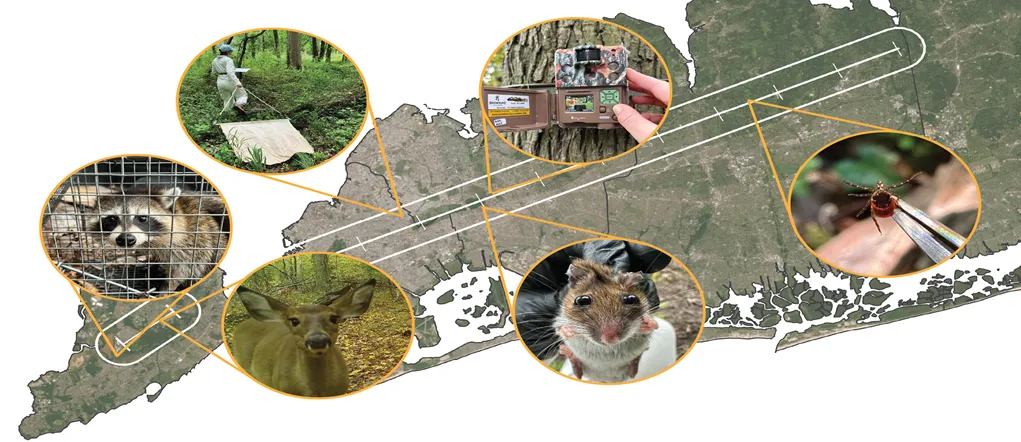
The New York City (NYC) metropolitan area is home to over 20 million people, with the highest human population density and geographic footprint of any city in the United States. Though sometimes called “the concrete jungle,” NYC contains a vast network of urban greenspaces that provide important refugia and habitat for hundreds of urban wildlife species, including important hosts of ticks and tick-borne pathogens such as white-tailed deer, raccoons, and mice.
We collaboratively created the first ever long-term Tick and Wildlife Urban Surveillance System (TWUSS) by pairing camera trapping methods developed by the Urban Wildlife Information Network and standard tick collections in accordance with CDC guidelines. The TWUSS includes over 50 sites selected across an urbanization gradient from NYC through Long Island, NY to monitor how ticks and their wildlife hosts respond to and emerge in urban environments.
Using this surveillance system, we have linked urbanization metrics across the gradient, keystone tick host (white-tailed deer) data from the wildlife cameras, and tick collection data to identify cascading effects of urbanized landscapes on wildlife host occupancy and tick-borne hazard intensity (See Lilly et al. 2025):
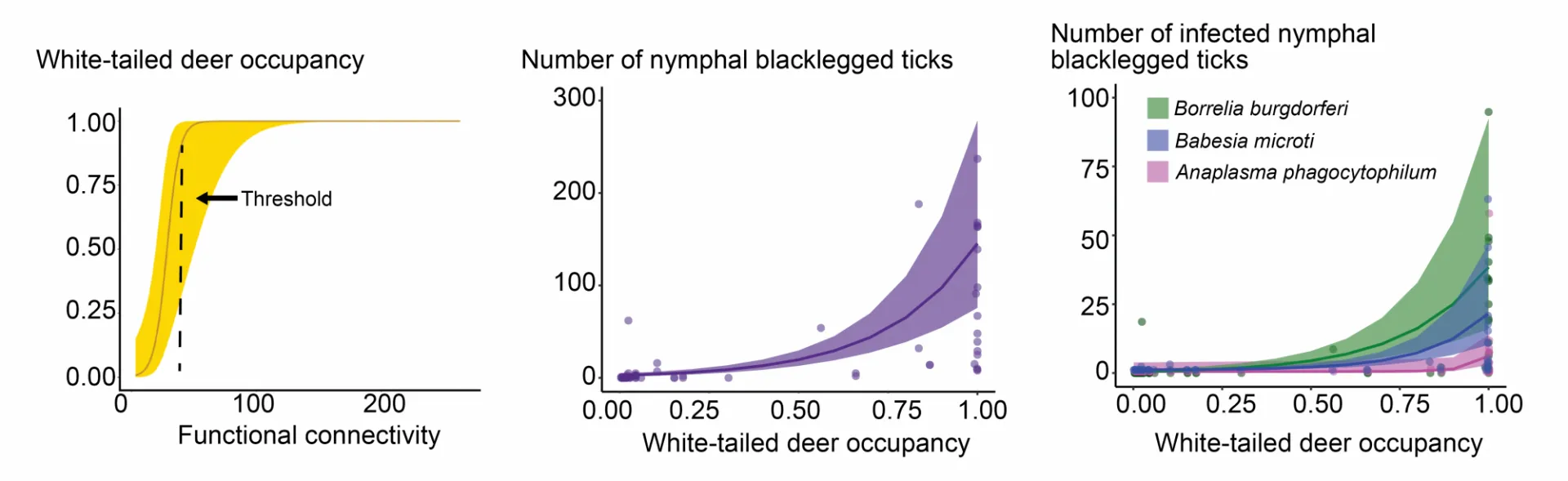
As NYC and other cities across the globe continue to grow, collaborative projects like the TWUSS will generate novel information and inform adaptive management responses to emerging zoonotic hazards in urban environments.

Publications from this project:
Lilly, M.V., Davis, M., Kross, S.M., Konowal, C.R., Gullery, R., Nagy, C., Poulos, K.I., Filippi, L., Corrao, S., Kopsco, H., and Diuk-Wasser, M. (2026). Cities as interfaces of zoonotic hazard emergence: development of the New York City Tick and Wildlife Urban Surveillance System. Journal of Visualized Experiments (JoVE) https://www.jove.com/t/69755/cities-as-interfaces-zoonotic-hazard-emergence-development-new-york
Lilly, M.V., Davis, M., Kross, S.M., Konowal, C.R., Gullery, R., Lee, S.J., Poulos, K.I., Gregory, N., Nagy, C., Cozens, D.W., Brackney, D.E., Fernandez, M.P., and Diuk-Wasser, M. (2025). Functional connectivity for white-tailed deer drives the distribution of tick-borne pathogens in a highly urbanized setting. Landscape Ecology.
https://link.springer.com/article/10.1007/s10980-025-02101-4